Home Harvest - MAGOBA Hybrid Maize: A Complete Guide for Ugandan Farmers
Early maturing, drought tolerant, and built for East African conditions — here's everything you need to know before your next planting season.
MAGOBA Hybrid Maize: A Complete Guide for Ugandan Farmers
Early maturing, drought tolerant, and built for East African conditions — here's everything you need to know before your next planting season.
If you grow maize in Uganda, you already know the hard truth: your harvest is decided long before you ever reach the field with a panga. It's decided the day you choose your seed. Plant the wrong variety for your land and no amount of weeding, fertiliser, or prayer will fully fix it.
MAGOBA is a hybrid maize variety we recommend to a lot of farmers at Home Harvest, and in this guide we'll walk through exactly what it is, who it suits, the numbers you can expect, and — most importantly — how to get the best out of it.
What is MAGOBA hybrid maize?
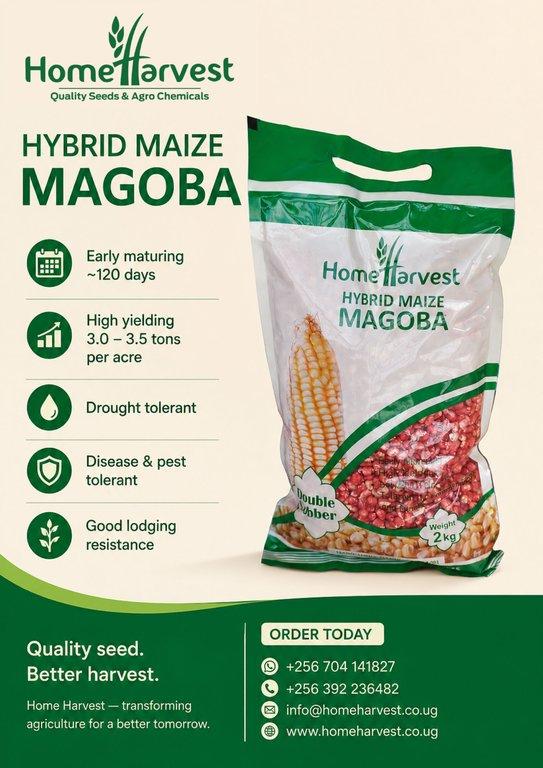
MAGOBA is a hybrid maize engineered for East African growing conditions. "Hybrid" simply means it's the result of crossing two carefully selected parent lines to combine their best traits — higher yield, faster maturity, and stronger resistance to the pests and diseases that cost local farmers so much each season.
Its headline strengths are:
- High yielding — significantly more grain per acre than traditional or recycled seed
- Drought tolerant — holds up better through dry spells, which matters more every year
- Disease and pest tolerant — built-in resistance to the common problems that hit maize in Uganda
- Early maturing — ready in about 120 days
- Good lodging resistance — strong stalks that stand up to wind and stay upright at harvest
The numbers that matter
For a farmer deciding what to plant, the agronomic figures tell the real story:
| Trait MAGOBA | |
| Days to maturity | ~120 days |
| Expected yield | 3.0 – 3.5 tons per acre |
| Best altitude | Low and medium altitude areas |
| Drought tolerance | Yes |
| Disease resistance | Yes |
| Lodging resistance | Good |
A yield of 3.0–3.5 tons per acre is a serious step up from what most farmers get from recycled or unimproved seed, where one to one-and-a-half tons is common. That difference is the whole argument for buying certified hybrid seed each season.
Is MAGOBA right for your farm?
The single most important question is altitude. MAGOBA performs best in low and medium altitude areas — which covers a large part of Uganda's maize-growing land, including much of the east, north, and central regions. If you farm in a high-altitude, cooler area, talk to our agronomists first, because variety choice changes with elevation and the wrong match is the most common cause of disappointing yields.
MAGOBA is a strong fit if you:
- Want a faster turnaround — at ~120 days it frees your land sooner for the next crop
- Farm in an area with unreliable or shorter rains, where drought tolerance protects your investment
- Are growing for market, not just home use, and need consistent, sellable volumes
- Have lost crops before to lodging or disease and want a tougher, more reliable variety
How to get the best yield from MAGOBA
Good seed is the foundation, but the yield on the packet is only reached when the agronomy is right. Here's how to give MAGOBA its best chance.
1. Prepare your land properly. A well-prepared, weed-free seedbed with good tilth gives seedlings the even, vigorous start that decides final yield. Don't rush this stage.
2. Plant at the right spacing. Correct spacing is one of the biggest free yield gains available to any farmer. The standard recommendation for hybrid maize is 75 cm between rows and 30 cm between plants (one plant per hill), or 75 cm × 60 cm with two plants per hill. Too close and the plants compete and produce small cobs; too far and you waste land. Our team can confirm the right rate for your specific field.
3. Time your planting to the rains. Plant at the onset of reliable rains so the crop has steady moisture through its critical growth stages. Even a drought-tolerant variety performs best when it's planted into a good season.
4. Feed the crop. Maize is a hungry plant. Apply a basal fertiliser at planting and top-dress with nitrogen (urea or CAN) when the crop is knee-high, around 4–6 weeks after emergence. This is when the plant is setting the size of its cob, so the nutrition you give now directly becomes grain later.
5. Control weeds early. The first 6 weeks are when weeds do the most damage, stealing water and nutrients from young plants. Keep the field clean through this window and the crop will largely look after itself afterwards.
6. Scout for pests. Even with built-in tolerance, walk your field regularly and watch for fall armyworm and stalk borer. Catching a problem early — before it spreads — is far cheaper than treating a full infestation. Our agronomists can advise on the right crop-protection products if you spot trouble.
7. Harvest at the right time. MAGOBA's good lodging resistance gives you a bit more flexibility, but aim to harvest once the grain has dried down properly. Drying maize correctly after harvest is also your best defence against aflatoxin and storage losses — get that right and you protect everything you worked for.
The bottom line
MAGOBA gives low- and medium-altitude farmers a genuinely strong package: high yield, early maturity, and the drought and disease tolerance that turn a gamble into a more dependable harvest. Paired with sound agronomy, it's one of the most reliable choices you can make for your maize season.
Ready to plant MAGOBA this season?
Stock moves fast ahead of planting windows, so reserve early. Our agronomists are also on hand to help you match the right variety, spacing, and inputs to your specific land — at no extra cost.
📱 Order via WhatsApp: +256 704 141827 📞 Call us: +256 392 236482 ✉️ Email: info@homeharvest.co.ug
🌐 Order online: www.homeharvest.co.ug
Home Harvest — transforming agriculture for a better tomorrow.

Just gonna try it this season and see its productivity